

Table of Contents
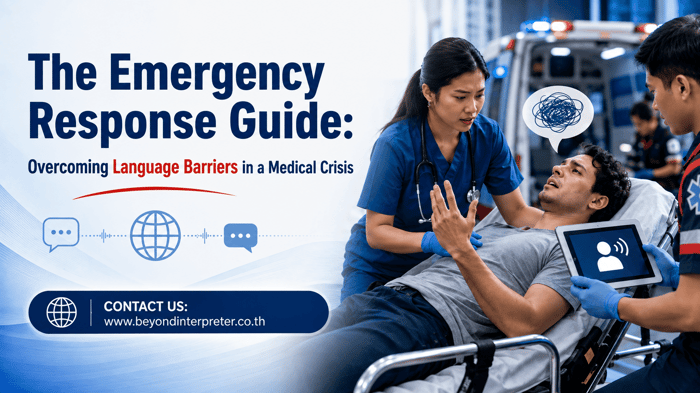
The Emergency Response becomes far more challenging when an accident happens abroad and the patient and doctor cannot understand each other. According to a study by Peleka et al., tourists facing medical emergencies in foreign countries typically encounter four major obstacles: language barriers, financial concerns, complex healthcare systems, and cultural differences.
If a medical emergency strikes in a rural province of Thailand, relying solely on translation apps won't cut it. Here is a practical, rapid-response guide designed for tourists, small local clinics, and helpful bystanders.
Part 1: For the Tourist (Preparation and Survival Tactics)
For The Emergency Response to be effective, proactive preparation is your best lifeline.
1. What to Prepare Before You Travel
- Medical Referral Letter: If you have a pre-existing condition, always carry a doctor's referral letter detailing your diagnosis, treatment plan, and a list of medications—written clearly in English.
- The Health Dossier: Compile your blood type, known allergies, vaccination records, and health insurance details. Keep physical copies and save the files on your phone.
A 30-Day Medication Buffer: Pharmacies in rural areas might not stock your specific medication or preferred brand. Bring enough medicine to last your trip, plus at least a 30-day backup supply.
Map the Nearest Hospital: Before booking accommodation in a remote area, pinpoint the nearest hospital. Ambulance response times in rural provinces are significantly longer than in major cities.
2. How to Handle an Active Emergency If you are injured in a rural area and face a severe language barrier, follow these steps:
- Call 1155 (Tourist Police) Instead of 1669: For a faster and more effective Emergency Response, dial 1155 if the local 1669 emergency medical dispatch does not have foreign-language speakers available. The Tourist Police hotline operates 24/7 and provides interpreters in eight major languages: English, Chinese, Japanese, Korean, Russian, French, German, and Hindi. Operators can assist as three-way translators and help coordinate an ambulance immediately.
- Use Locals for Navigation: Pin your location on Google Maps, put 1155 on speakerphone, and hand your device to a local Thai person nearby so they can explain your exact coordinates.
- The Lock Screen Hack: Translate your critical health info (allergies, blood type) into Thai, save it as an image, and set it as your phone's lock screen. If you lose consciousness, paramedics can access this vital information without needing your passcode.
- First Aid Skills and Gear: Carry a basic first aid kit and learn how to perform CPR to help stabilize a patient while waiting for a rural ambulance to arrive.
3. Before Discharging from the Hospital As part of The Emergency Response process, always request a detailed Medical Summary before leaving the hospital. It should clearly outline the treatments performed and medications administered so your doctor back home can safely evaluate your condition and continue your care.
Part 2: For Local Clinics and Bystanders
For The Emergency Response to be effective, local clinic staff and good Samaritans helping foreign tourists in distress must know how to overcome communication barriers without relying on complex technology.
- Dial 1155 for Immediate Translation: Call 1155 and use the speakerphone. The center provides 24/7 interpretation for 8 major languages (English, Chinese, Japanese, Korean, Russian, French, German, and Hindi). They can assist with translating initial triage questions and ensuring everyone understands the situation.
- Build a Translation Network Proactively: Don’t wait for an emergency to start looking for translators. If you notice an influx of tourists or expats in your area, clinics should proactively reach out to local rescue volunteers or expat groups to see who can speak which languages. Build a contact list so you can call them in during a crisis. Additionally, keep a list of professional medical interpreter agencies (both local and international) on hand for urgent Remote Interpreting via phone or video call.
- Use Visuals to Communicate:
For Clinics: As part of The Emergency Response process, clinics should keep laminated visual aids at the front desk. These should include an anatomical chart that allows patients to indicate where they feel pain, icons for common emergencies such as animal bites and open wounds, and a Visual Pain Scale. The pain scale is a self-assessment tool, so medical staff and rescuers should never determine pain levels by observing the patient’s facial expression. The patient must point to the chart themselves.
For Bystanders: As part of The Emergency Response, bystanders can use simple images on their phones, such as a picture of a hospital, to reassure the injured person and clearly communicate where they are being taken.
- Voice-to-Text Apps: Use the voice-command feature on translation apps to quickly ask critical questions like, "Are you allergic to any medicine?" or "Where does it hurt?"
- Clear Pricing Transparency (For Clinics): Foreign patients often worry about costs and fear being overcharged. Because healthcare costs are extremely high in some countries, patients might refuse treatment if they assume Thai prices are similar. Clinics should display an initial price list (e.g., Consultation Fee: ___ Baht, X-Ray: ___ Baht) in multiple languages before starting treatment to ensure transparency and reduce anxiety.