

Table of Contents
Sounds familiar? You’ve spent weeks preparing paperwork to study abroad, apply to a multinational company, or sign an international business contract... only to end up stuck at the counter, totally frustrated because the officer rejected your documents over a minor mistranslation or the wrong certification stamp.
Document certification isn't about beautiful prose. It’s about using the exact official terminology required by the receiving agency and understanding legal certification rules so your documents hold 100% legal validity.
Instead of rehashing the same generic steps you can find anywhere, this article shares insider insights to help you navigate the system like a pro, catch mistakes before they happen, and save both time and money on resubmissions.
The Golden Rule: Know Your Agency's Requirements First!
Before hiring a translator, your very first step should always be to check the exact regulations of the receiving organization. Requirements vary wildly depending on the embassy, institution, or government body.
1. Are Your Documents "Outbound" or "Inbound"?
Getting this right is the first step to avoiding delays:
- Thai to English (Outbound): For people heading abroad, this involves submitting official Thai government documents (e.g., birth certificates, household registrations, marriage certificates) to foreign embassies or overseas organizations.
- English to Thai (Inbound): For bringing foreign documents into Thailand to submit to Thai government agencies.
2. The "Strictness" Level: Who Needs to Sign Off?
Once you know your destination, determine what level of certification is required. These generally fall into three main tiers:
Level 1: Official Government Documents — Consular Legalization
- Document Types: Civil documents meant for international use, such as birth certificates, household registrations, ID cards, marriage certificates, name-change certificates, or police clearances.
- Certified By: Department of Consular Affairs, Ministry of Foreign Affairs.
- Pro Tip: The Thai Department of Consular Affairs only authenticates documents in Thai and English. If your original document or translation involves a third language, consular officers will reject it. You must translate it into English first, have it certified by that country’s embassy, and then translate the English version into Thai.
Level 2: Personal & Professional Documents — Certified Translation
- Document Types: Qualifications for education or job applications, such as academic transcripts, degrees, employment letters, resumes, or bank statements for visas.
- Certified By: The translator or a professional translation agency.
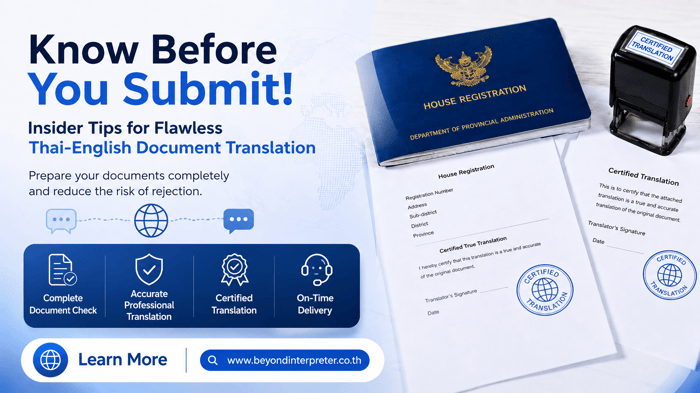
- Key Detail: The translator must stamp and clearly state "Certified Correct Translation," along with their signature and a valid contact number. (Note: The text on the certification stamp must be in the same language as the translation).
Level 3: Cross-Border Business & Legal Transactions — Notary Public
- Document Types: Corporate transactions or high-level identity verification, such as Powers of Attorney (POA), international sales contracts, Company Registration Affidavits, or foreign bank account opening forms.
- Certified By: A licensed Notarial Services Attorney.
- What People Get Wrong: A Notary Public does not read through every translated word for accuracy. Instead, they legally verify that the translator is a real person who personally signed the document in the attorney's presence, preventing identity fraud or forged signatures.
The Ultimate Hurdle: Strict Agencies (The FDA and Courts)
If you need to submit documents to notoriously strict Thai agencies like the FDA (Food and Drug Administration) or the Courts, an accurate translation alone isn't enough. Officers will actively scrutinize the translator's profile.
These agencies usually expect translators to hold at least a bachelor’s degree (in any field) alongside credible experience proving their ability to translate complex legal or technical material.
Pro Tip: To avoid getting your paperwork rejected, always ask your translator to provide:
- A copy of their degree (preferably language-related), signed as a certified true copy.
- A copy of their ID or passport, signed as a certified true copy.
Make Document Translation Easy
Document translation doesn't have to be a headache when you understand the rules. Partnering with professional translation experts like Beyond Interpreter ensures a smooth, hassle-free experience from start to finish—saving you time, money, and frustration.
[Get a Free Document Evaluation from the Experts]
Let our professional team handle your documents. Send your files and translation requirements to:
- Email: info@beyondinterpreter.co.th
- LINE: @beyondinterpreter