

Table of Contents
AI translation may be getting faster and smarter, but it still falls short in high-stakes, sensitive situations. AI lacks ethical judgment, empathy, and real-time contextual awareness. Professional human interpreters know how to protect third-party rights, show compassion, and step back when a question falls outside their scope—qualities no algorithm can replicate.
Lessons from Varvara Davydova: A Real-World Masterclass in Crisis Interpreting
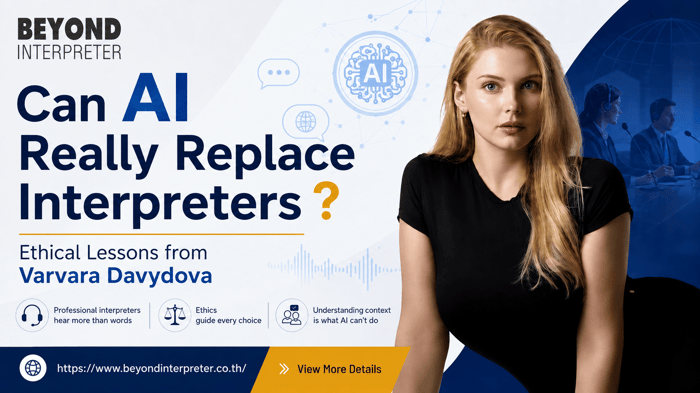
The actions of Russian-Thai interpreter Varvara Davydova offer a powerful lesson in professional crisis communication.
At a police station packed with press, Davydova was interpreting for a Russian volunteer. Reporters repeatedly asked leading questions about the emotions and thoughts of the victim’s family, who were not present.
Rather than letting the high-pressure environment push her out of her lane, Davydova stayed composed. She respected the family's privacy and established her professional boundary clearly and politely.
This was not just about getting the grammar right. It was about poise, ethics, and empathy—the exact reasons humans remain essential in sensitive communication.
Three Ethical Boundaries AI Cannot Cross
Davydova’s conduct highlights three fundamental limitations current AI cannot overcome:
1. Staying Within Scope Under Pressure
AI models are built to generate answers. When fed leading questions or nudged for an opinion, an AI system tries to craft a plausible response from its data. In a sensitive setting, that means it risks overstepping, compromising privacy, or making false assumptions.
Human interpreters know better. They distinguish between translating what was said and stepping into commentary. Knowing when to politely decline a question is a form of judgment AI simply does not have.
2. Empathy and Respect for Third Parties
Language carries weight, especially around grief and trauma. In this case, Davydova recognized that the family was absent and that speculating on their feelings would be disrespectful.
That level of empathy allows human interpreters to gauge vulnerability and choose restraint or silence when appropriate. These are human nuances an algorithm cannot feel.
3. Real-Time Risk Mitigation
Real-world crises are fluid and unpredictable. Answering press questions surrounded by microphones demands immense composure. A human interpreter serves as a vital buffer—buying time, steering the dialogue, and protecting every party involved from legal or reputational harm.
Conclusion
As AI takes over routine document translation and everyday language tasks, cases like Varvara Davydova’s remind us why high-stakes communication still demands human professionals.
Grammatical accuracy is a technical problem. But reading a room with compassion, holding a hard line on professional boundaries, and honoring human dignity are things code will never replace.